Short answer
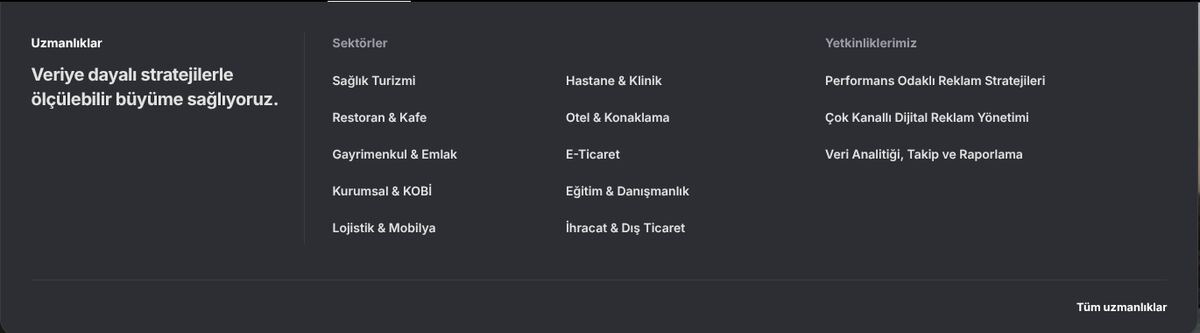
UNIT İstanbul's expertise section explains how the agency builds digital marketing around each sector. From health tourism to exports, every sector page covers the customer's decision process, the sector's regulatory limits and the channels that work together, while the Capabilities heading groups advertising strategy, multi-channel ad management and data analytics.
Highlights
- Sector pages: health tourism, hospitals and clinics, restaurants and cafés, hotels, real estate, e-commerce, corporate and SMEs, education, logistics and furniture, exports.
- In every sector, success is measured not by clicks or impressions but by business results such as appointments, bookings, sales and quote requests.
- Capabilities: performance-led advertising strategy, multi-channel ad management, and analytics, tracking and reporting.
4 min readAuthor: UNIT Journal EditorEditor-in-chief: Uğur Deniz İlhan
UNIT İstanbul, the publisher of UNIT Journal, is a digital marketing agency. This series explains what the agency does for brands; this part is about sectors. The site's expertise menu has two parts: the sector pages and the Capabilities heading.
Which sectors does the agency specialise in?
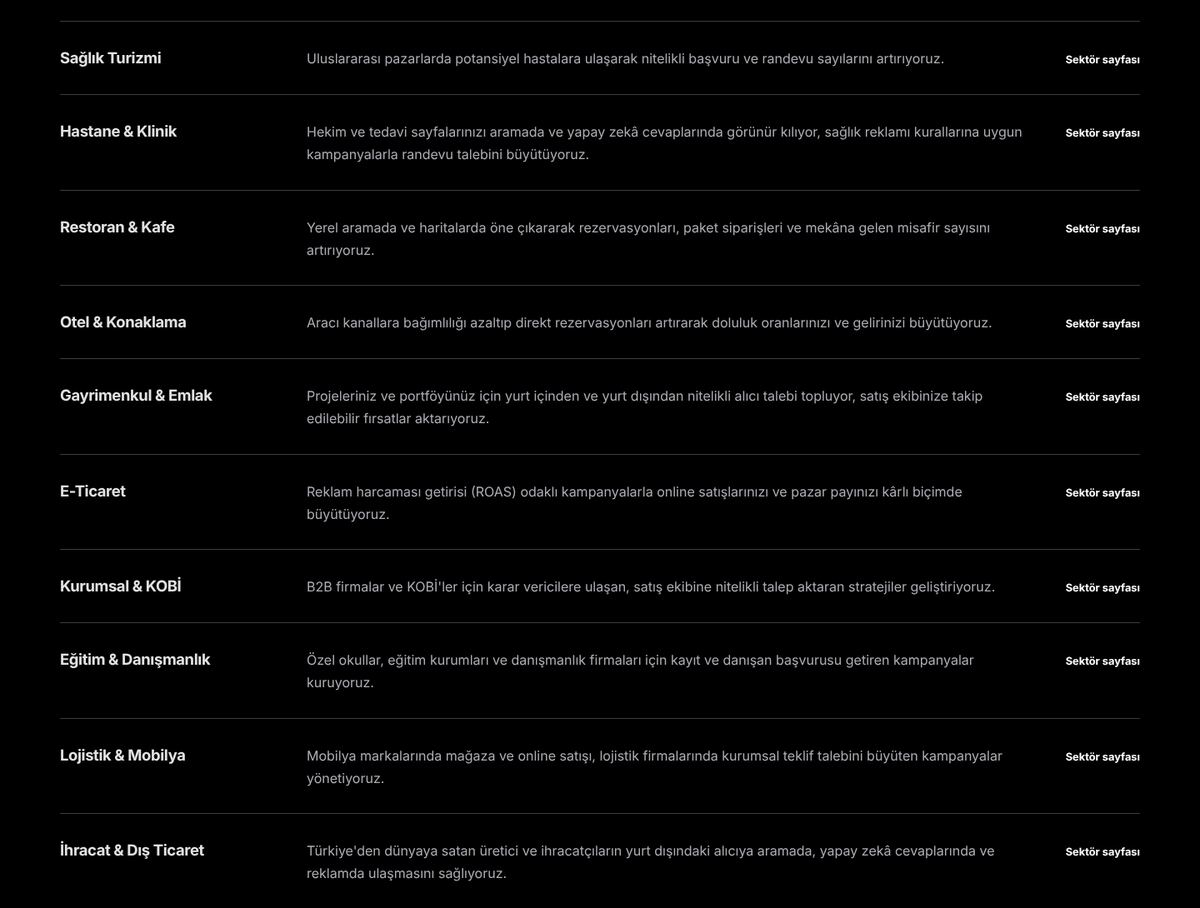
Every sector page describes the customer's decision process, the sector's regulatory limits and the channels that work together. What the pages share is that success is measured not by clicks or impressions but by the sector's business result:
| Sector | What is done | Measure of success |
|---|---|---|
| Health tourism | Reaching patients abroad in search in their own language, in AI answers and on social media; multilingual SEO, AEO and performance ads | Qualified enquiries and appointments that take place |
| Hospitals and clinics | Doctor and treatment pages, local search and ads that follow healthcare advertising rules | Appointments booked and calls received |
| Restaurants and cafés | Google Maps visibility, reviews, Instagram content and location-targeted ads | Reservations, direction requests and orders |
| Hotels and accommodation | Ads that protect searches for the hotel's name, destination SEO, remarketing to past guests | Occupancy and direct booking revenue |
| Real estate | Ads for domestic and foreign buyers, project and area pages, CRM integration | Enquiries that turn into meetings and sales |
| E-commerce | Google Shopping and Meta ads, product and category SEO, on-site conversion improvements | Return on ad spend and profitability |
| Corporate and SMEs | Sector SEO and content, LinkedIn and Google ads, brand identity | Enquiries and quote requests that reach a sales meeting |
| Education and consulting | Programme and service pages, ads planned around enrolment periods, application tracking | Applications, meetings and confirmed enrolments |
| Logistics and furniture | Product and store-visit campaigns for furniture, service pages and decision-maker ads for logistics | Sales and quote requests |
| Exports and foreign trade | Multilingual sites, Google, LinkedIn and Yandex campaigns in target countries, international SEO and AI visibility | Incoming quote requests |
What is under the Capabilities heading?
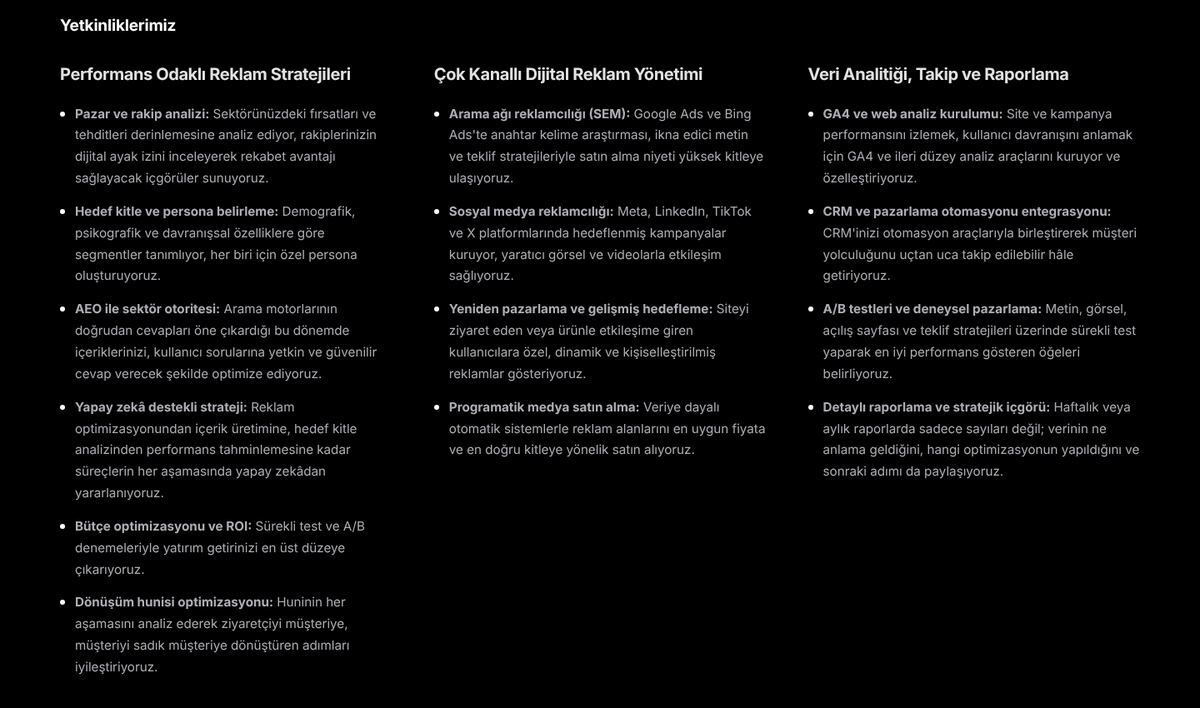
Alongside the sectors, the agency's sector-independent capabilities are grouped under three headings:
- Performance-led advertising strategy: market and competitor analysis, audience and persona definition, sector authority through AEO, AI-assisted strategy, budget optimisation through continuous testing and A/B experiments, and funnel optimisation.
- Multi-channel ad management: search advertising on Google Ads and Bing Ads, social advertising on Meta, LinkedIn, TikTok and X, retargeting and advanced targeting, and data-driven programmatic buying.
- Analytics, tracking and reporting: GA4 and analytics setup, CRM and marketing automation integration, A/B testing and experimentation, and weekly or monthly reports that also cover what the data means and the next step.
Why separate sector pages?
Every sector has a different decision process. A patient abroad starts researching treatment on Google, in ChatGPT and on social media; a home buyer researches the project, the area and the developer for a long time; in B2B, a purchase needs several people's approval; a guest often decides where to go on their phone within minutes. Some sectors, such as healthcare advertising, also have their own regulatory limits. The sector pages bring these differences, the key services and related work together; the health tourism and exports pages are two examples.
The channels used in sector work are detailed on the agency's service pages, led by SEO, Google Ads, Meta Ads and local SEO.
For a conversation about your sector, you can reach the agency through the contact page.
Disclosure: UNIT Journal is published by UNIT İstanbul; this article describes the agency's own services.
Frequently asked
- Which sectors does UNIT İstanbul work with?
- The sectors with their own page on the site are health tourism, hospitals and clinics, restaurants and cafés, hotels and accommodation, real estate, e-commerce, corporate and SMEs, education and consulting, logistics and furniture, and exports and foreign trade. Each page covers the sector's decision process and the channels that work together.
- How is success measured by sector?
- Not by clicks or impressions but by the sector's business result: appointments for a clinic, direct bookings for a hotel, return on ad spend and profitability in e-commerce, and enquiries that reach a sales meeting in B2B.
Links
Sources
- UNIT İstanbul — Uzmanlıklarımız ·
- UNIT İstanbul — Sağlık Turizmi için Dijital Pazarlama ·
- UNIT İstanbul — Hastane ve Klinikler için Dijital Pazarlama ·
- UNIT İstanbul — Oteller için Dijital Pazarlama ·
- UNIT İstanbul — E-Ticaret için Dijital Pazarlama ·
- UNIT İstanbul — İhracatçı Firmalar için Dijital Pazarlama ·
Follow UNIT Journal
What's new in search, AI and technology, in your feed every day.


